





- Schedule your wellness exams (annual physical, etc).
- Schedule your preventive screenings (mammogram, colonoscopy, etc).
- Utilize in-network Labs for all laboratory testing.
- Visit your Primary Care Physician before seeing a Specialist.
- Use Urgent Care instead of an Emergency Room.
- Use Telehealth or Telemedicine.
- Filling Generic Prescriptions




- Medical expenses not covered by your medical plans, such as your deductible or coinsurance.
- Ongoing living expenses, such as your mortgage or rent.
- Directly to you
- As a lump sum
- In addition to any other coverage, like medical or an Accidental Death & Dismemberment (AD&D) plan
- Accidental death
- Dismemberment
- Dislocation or fracture
- Initial hospital confinement


- Your contributions are deducted from your paycheck on a before-tax basis in equal installments throughout the calendar year.
- As you incur health care or dependent care expenses throughout the year, submit a claim form for reimbursement or use your FSA card to pay for eligible expenses.
- Please note that these accounts are separate—you may choose to participate in one, both, or neither. You cannot use money from the Health Care FSA to cover expenses eligible under the Dependent Care FSA or vice versa. You cannot enroll in a Health Care FSA if you are enrolled in a Health Savings Account (HSA).
- The maximum contribution for 2023 will be $2,850 for the Health Care Flexible Spending Account and $5,000 for the Dependent Care Flexible Spending Account.
- Please review eligible expenses for each account to ensure the proper election. Note: the Dependent Care Flexible Spending Account is to be used for daycare and after-school care; not for the dependent’s medical expenses. Eligible expenses are listed on the Lifetime Benefit Solutions Website.

- You and Liberty can add funds into the HSA that are not subject to federal income taxes** up to the IRS limits. For 2023, the maximum contribution amounts are $3,850 for individual coverage and $7,750 for family coverage. An additional $1,000 can be contributed for those age 55 or older.
- The HSA allows you to pay for qualified medical, dental and vision expenses with these tax-free funds.
- The account can earn interest on a tax-free basis, and you are allowed to roll funds over year after year.
- If you leave Liberty, or retire, you can take your HSA with you.
- It is important to carefully consider the amount you choose to elect, because you can not change your annual election unless you experience a mid-year qualifying event.


Liberty National plan details are reflected in the descriptions above. For Union coverage details, please see HR.

Disability benefits do not apply to part-time employees.

- Yourself: in $10,000 increments up to $500,000, not to exceed 5 times your annual earnings. You may be subject to complete an Evidence of Insurability Form Request for amounts over $100,000.
- Your spouse: in $5,000 increments up to $100,000, not to exceed the employee election. Your spouse may be subject to complete an Evidence of Insurability Form Request for any amount over $25,000.
- Your child(ren): $1,000, $2,000, $4,000, $5,000 or $10,000. You pay one rate for all children covered.

- You do not have to be terminally ill to receive benefits.
- Coverage options are available for your spouse/domestic partner and children as riders to your coverage.
- Coverage is portable—you can take your policy with you if you change jobs or retire.

- Legal information, resources, and consultations
- Financial information, tools, and resources
- Identity theft counseling
- Child and elder care referrals



- Hotel Discounts
- Amusement Park Tickets
- Concert Tickets
- Electronics Fitness
- Restaurants
- Home, Auto, Pet Insurance, and more….

Liberty’s 401K plan assists you with saving for retirement. Your total deferral amount can be from 1% to 80%. Contributions will be deducted for your pre-tax Traditional 401(k) account meaning the money comes from your pay before income taxes have been deducted or contributions will be deducted from your pay after income taxes have been deducted for your Roth 401(k) account.
Liberty will match contributions equal to 100 % of your contribution up to 5% of your compensation. This rate may differ for union employees. If you are covered by a union contract, Liberty will match your contribution as outlined in your applicable union agreement.
Eligible members can follow the enrollment Guide to open an account and elect their deferral.
Voya Financial is our carrier. With an account you can access:
- Account balance
- Investments
- Loans
- Review and designate your beneficiaries
- Quick links to money management tools to identify retirement savings needs and track your strategy
Employees have the option to transfer their funds from their previous 401k plan/IRA to the Liberty plan. Once the Voya Rollover form is completed, please return to the Liberty Pension Department.
Participant Contact Center Number: 1-800-584-6001

Liberty Cash Balance Pension Plan
Liberty’s retirement pension plan is a Cash Balance Pension plan (except for Grandfathered members who are in the Defined Benefit Pension Plan). Employees are enrolled into the plan on the first day of the month after completing one year of “Eligible Service”, which equals 1,000 or more hours of service during 12 months of employment (see Summary Plan Description for more details).
Benefits
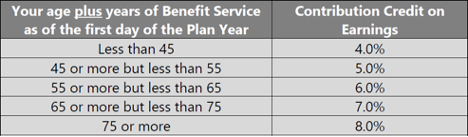
Annual contribution credits are made to your account with 1,000 or more hours of service during the year. The benefit provided at termination or retirement is the accumulation of contribution and interest credits through your years of service.
The contribution credit is a percentage of your earnings based on your age plus years of service. W-2 earnings x % = Contribution credit
CBIZ RPS Benefits Service Center
Participants in the Plan should register on the CBIZ Retirement website to access their account.
The website allows participants to review their personal information, employment details, request estimates, upload documents (birth certificates, marriage certificates and death certificates) and initiate their retirement or distribution process.
Terminations & Retirements
Participants in the Liberty Cash Balance Plan or participants that participated in the former Empire Retirement Plan (Empire Traditional -Formula and Empire Cash Balance Pension Plan) can complete election forms online.
Other participants in the Liberty Defined Benefit Plan and the St. Lawrence Gas Retirement Plan can begin the application process on the website. At this time, however, calculations must be completed by CBIZ actuaries off-line and forms are mailed to participant’s home for completion rather than being available through the website.
Participant Contact Center Number: 1-844-534-3556
Employee Share Purchase Plan (ESPP)
The Employee Share Purchase Plan (ESPP) is an employee reward program that gives employees an opportunity to own company shares through their own contributions. It is meant to complement Liberty’s compensation and other benefit programs. As part of the program, you will receive company matched contributions. For contributions up to $5,000 each calendar year, Liberty will match it at 20% (or up to $1,000). For contributions over $5,000 up to $10,000 each calendar year, Liberty will match it at 10% (or up to $500). The annual employee contribution maximum under the plan is $10,000, for a maximum Company match of $1,500.
The ESPP is a voluntary program available to all employees who qualify for other benefit programs. You can activate your account and enroll at any time.
Blackout Periods
A blackout period is a timeframe established by the Company during which share transactions are prohibited, typically around the time when the Company releases its quarterly reports or when there are significant events which might be perceived to impact the Liberty’s performance. Blackouts are defined in the Company Insider Trading Policy, which governs all trading activities and all employees are responsible to adhere to them.
During blackouts participants are prohibited from trading shares, increase or decrease contribution amounts, sell or transfer shares, and stop participation in the Plan. However, blackouts do not interfere with regular ongoing contributions through payroll deduction established before the blackout period.